Patience

We were given this hope when we were saved. (If we already have something, we don’t need to hope[b] for it. But if we look forward to something we don’t yet have, we must wait patiently and confidently.)   ~Romans 8: 24-25

“Ugh, it’s hard to wait!” my three-year-old whined from the back seat. “I know, buddy. We still have a little while to go. Wanna listen to some music?” I asked.

This refrain has often been my son’s dramatic response to so many things in his little life. On this particular day, I was driving him and his sister to my parents’ house, about an hour away. He let out this little cry of frustration about 15 minutes into the ride. “Oh, this is gonna be fun,” I thought to myself.

And while I have yet come up with a kid-friendly way to say “Son, remember how in Romans Chapter 8 God instructs us to wait patiently? Do that and shut it!” I can, thankfully, remind myself of this very principle when I get antsy, and whine to God about how hard it is to wait.

Ah, waiting. It’s the virtuous thing to do, right? Delayed gratification is a sign of maturity, they say. Good things come to those who wait, they say. “Yeah, right,” I say. Waiting is hard work. Waiting is especially hard when you feel like you’ve prepared, you’ve done your part and you’re waiting on God to make or reveal a pathway to the thing that you want.

You could be waiting to find just the right house to move into, or the right person to date, or the right job offer, or the right time to have kids (girl, don’t rush it!) The truth is, it’s a challenging task to continuously pray and wait for God’s perfect timing.

But that’s exactly what the Lord instructs us to do. In the passage above, Paul is talking about waiting for the second coming of Jesus, but surely, this principle applies to waiting for anything we are anxious and ready to receive.

If we don’t have the thing we’ve been praying for, we wait patiently–and confidently–for God to respond. And good thing we don’t have to do this on our own. If God instructs us to wait patiently on him, surely he will help us to follow his instructions. So our prayer becomes “God, this is the thing I truly desire. I pray for it AND I also pray for the patience to wait on your timing.”  (We also need to be sure that the thing we’re praying for is what God truly wants for us, but that’s another post!)

Ultimately, we have to remember that God loves us (1 John 4:10), He cares for us (1 Peter 5:7) and He has an ultimate plan for us (Ephesians 2:10). He’s not some spiteful Dad toying with our emotions, just refusing to give us the things for which we ask. He’s a good Father who can see farther than we can and knows more than we do. We trust Him in the waiting, knowing that all of his plans for us are good (Jeremiah 29:11).

 

On Current Events

It is difficult to be Black in America. I don’t presume to speak for all Black people, but I know how I feel. To face lethal hatred and racism on an individualized level (Travon Martin, Eric Garner, Jordan Davis, Tamir Rice, Philando Castile…) and to also face that same lethal hatred and racism en masse in enraged white faces in the dark of night, lit by torches evoking the lynch mobs that extinguished so many of my people before me—it is just too much.  To be able to draw parallels regarding the treatment of Black people from  1917 to 2017 is just simply unreal and more than any one person, anyone people, should have to bear.

To wake up each day and determine that you will be the best version of yourself in a city, state, a country that seems to want to mute your very existence—this is a heavy thing. To turn on the evening news and have to explain the terms “mob” “hate” and “race” to your four year old is painful. To have to tell her that people hate her because of who she is and how she looks—that’s utter agony.

But I can’t stay in this place. I push forward. I keep fighting.  The only reason I exist today is because my ancestors did the same. And I owe it to them, I owe to my children, to my people to continue to be my best self and stand up and give a voice to the voiceless and bring hope and restoration to broken places.

And no, hope and restoration may not come in the form of a grand speech in front of millions of people, or even martyrdom. But I know that I can push forward, show love, and bring  hope in my daily life: in the legal representation that I give to people, in the way I teach my children to love themselves no matter what anyone else says about them, in my utter refusal to hate people who hate me. I will continue to move forward, to press forward. I will continue to show love. That is my Father’s will—for us to love one another as He loves us. And as I pray daily, let my Father’s will be done.

Ponytails and Gratitude

Keep your lives free from the love of money and be content with what you have, because God has said, “Never will I leave you; never will I forsake you.”

~Hebrews 13:5 (NIV)


“Mommy I don’t want buns, I want ponytails!” From the driver’s seat of my parked car, I turned and looked back at my four-year-old incredulously. “What did  you say?” I asked. “I want ponytails, I don’t want buns in my hair!”

“I know this girl is NOT sitting up here complaining about her beautiful hair when I just spent the money and time taking her to the salon so her hair could look so nicely and neatly braided,” I thought to myself.

I took a deep breath and launched into a mini lesson (read, lecture) on why it was important to be grateful for what we do have, and not always focused on what we don’t have, instead. The “lesson” included phrases  like “you should appreciate your hair” and “mommy didn’t have to take you to the salon” and “I’m sure there are a lot of little girls who would love…” You get the picture.

“Do you understand?” I finally asked her, swinging my body back around in my seat and pressing the start button, all in one indignant motion. I began to drive and immediately started my internal monologue about my four-year-old and what I could do to make her really appreciate the things that she’s been given. Then I thought about God. And human beings. And how we’re just like my ungrateful, precious little girl.

How many times do we think “oh, if only I had her job” or “I’d be feeling great too, if I had her body” or “I mean, can I live in a house like that?” Those thoughts ricochet around my brain daily, while I constantly overlook all of the great things I do have. I have to frequently remind myself that God didn’t have to give me anything–not gainful employment, not healthy children, not a loving husband, not healthy parents, nor great friends.

Don’t get me wrong: ambition certainly has its rightful place in our lives. I don’t think God called us to be complacent–never trying to better ourselves or achieve more for his glory. However, I do think God calls us to be content while we climb, to be grateful as we grasp for greater. He wants us to stop covetously looking at everyone else’s lives, and realize, as Hebrews 13 reminds us, that we have the best gift of all: his presence.

So maybe instead of lecturing my little munchkin, I’ll set the example for her. Thank you, Lord, for all that you have given me. You didn’t have to bless my life in the ways that you have, and I am so grateful for what you’ve done for me. And most of all, I am grateful for you. Amen.


A Sweet Exchange


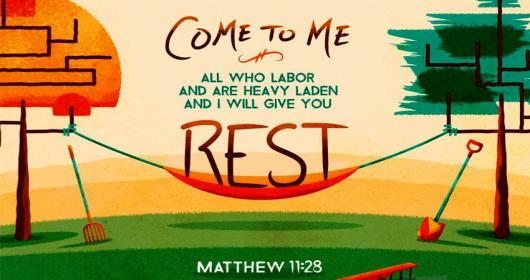
matthew-11-28

Then Jesus said, “Come to me, all of you who are weary and carry heavy burdens, and I will give you rest.  Take my yoke upon you. Let me teach you, because I am humble and gentle at heart, and you will find rest for your souls. For my yoke is easy to bear, and the burden I give you is light.”  

~Matthew 11:28-30 NLT

Last weekend, my friends and I had a “Mommy’s Day Out.” So. Much. Fun. We hung out together for the better part of Saturday afternoon and on into Sunday.  Hanging out included going to a Mexican restaurant for an early dinner. When we arrived, the restaurant was crowded and the wait time was long, so we decided to eat at the bar.

As we sat chatting and waiting for our food and drinks, I noticed a couple sitting next to us. They were quietly talking, kissing and seemingly enjoying themselves as well. And then they got up to leave. The girlfriend got up with ease, but the boyfriend got up and almost immediately fell over onto my friend. He grasped for the high seat back, and then rocked too far forward as he tried to overcorrect. This guy was drawing attention to himself as he tried desperately to steady himself. As he was trying to catch his balance, he told his girlfriend, standing next to him, “I’m not OK.” And I’m thinking, “dude, you are more than just ‘not ok.'”

As the couple walked away, I judgmentally rolled my eyes. It was about 5:00 pm at this point.  Like seriously, the evening had barely started and this guy was lit. Toasted.  Sloshed. The craziest aspect of the whole scene was that the guy was so quiet and indistinct before he tried to leave. I acted disgusted for a few more minutes as I pondered this guy’s situation and then carried on with the rest of dinner.

I didn’t think about that guy again until the following night, as I was deep in a, shall we say, heated exchange with my husband about a specific issue. I was completely exasperated and frustrated. All of this emotion had built up inside of me and I felt like I was just about to explode with anger.  And then I thought to myself “I’m not OK.”

Our conversation ended and I went upstairs to my bedroom. I closed the door and opened the Bible. Soon I found Jesus staring back at me from the book of Mark, beckoning me to come and tell him about what was on my mind.

My husband wasn’t the real issue. After praying and thinking, I realized that I had had such a good time with my girlfriends, that it really kind of magnified for me just how stressed I had been and how much I needed a break, even just a short one. The issue with my husband was just the symptom. He’d been doing a really great job of sharing the collective load of juggling jobs, kids and household maintenance. But sometimes life can still be stressful and pressure-filled, even with your partner right beside you.

I was not OK and I didn’t need to tell my husband about it, I needed to decompress and tell Jesus about it. So there I was, the same person who had so quickly doled out judgment on someone else, kneeling at my bedside, uttering those same words to the Lord. In all my busyness and stress and watching other people, I hadn’t taken the time to locate my own feelings and read up on what Jesus had to say about them. In the past few weeks, I hadn’t really taken concentrated time to pray and tell God what was going on in my day to day. I took the time that night though, and it was great. It was what I needed. I gave Jesus my burdens that night.

And the funny thing is, nothing about my daily life changed– the demands of being a wife, mom, attorney, daughter, they were all still there. But man, did I have peace after that time with Jesus. His burden really is light–if I take the time to exchange it for mine. And even in the week after that episode, I still struggled to find the time to devote solely to Jesus, but that devotional time that I did have was a reminder of why and just how much I need him. He can bear the burdens of this fast-paced, filled-to-the-brim life. He will give me rest for my soul as I walk out this life day by day. And I’m more than OK with that.


Graphic Credit: dailylifeverse.com

Better Than “Eat, Pray, Love”?

learn-how-to-become-a-better-person

Philippians 4:5-9 NLT

I never read the book (or saw the movie) Eat, Pray, Love. I actually recently took a poll with some of my friends to ask if it was worth the listen on Audible. I have to admit that even now, ten years after it was first published, the title still entices me. Any memoir that instructs me to eat, pray and love to find a better life, I’m here for it. Reading through Philippians, though, I stumbled across what I consider to be Paul’s formula for living a God-filled (read, fantastic) life: Pray, Think, Do.

Pray

In Philippians 4:5-7, Paul is writing to the church at Philippi, giving them instructions on how to conduct themselves in his absence. He encourages them that God is near and that they don’t have to worry or be overly anxious about their lives. And neither should we. We should pray instead, he says, giving thanks for what we have and asking God for what we want and need. When we do this, we can expect the peace of God to envelop us. So the first step is to pray. “God, I thank you for blessing me with two wonderful kids. I pray that you would help me figure out how to make them go to sleep at bedtime without having to bribe them with promises of breakfast treats in the morning. Amen.” Ah, I feel the peace coming now.

Think

Then, in Philippians 4:8, Paul instructs the church on how they should be thinking.  If something is true, noble, right and pure, he says, then they should think about that thing. I admittedly add my own interpretive spin to this portion of Paul’s writing.  In the plan for living, I think Paul’s directive on our thoughts also means that we should think, as in formulate a plan of action, for our lives or a specific area of our life that we have been praying to God about. Here is our second instruction: think. Because my kids take so freakin’ long to fall asleep, maybe I should put them down earlier, so they still get a decent amount of sleep at night. This may very well be easier said than done, but remember, I’m still thinking here.

Do

And then finally, in Philippians 4:9, Paul admonishes the church at Philippi that whatever they have learned from him–whether they saw him do it or heard him say it, they should follow his godly example and do those things, too. Thus, we have our third and final instruction: Do. It’s taking everything in me not to insert some corny line that includes the Nike slogan, so let’s just move right right along, shall we? The most important part of the equation (according to James 1:22-25), we have to follow through on the plan that we created while we were thinking. We have to act. Tomorrow evening I won’t scroll through my IG feed while running the kids’ bath water or warming up their food. I will not lock myself in the bathroom (where they can’t get to me) so that I can rummage through my FB feed in peace. I will have a focused, streamlined evening routine so that the children can get their little tails in the bed earlier.

And there you have it: Pray, Think, Do. Thanks Paul. And also, Jesus. (This example may or may not have been taken from my real life. All names and references were changed to protect the innocent. But not really.)

Parenting 101


And I am convinced that nothing can ever separate us from God’s love. Neither death nor life, neither angels nor demons, neither our fears for today nor our worries about tomorrow. . .   ~Romans 8:38 NLT


“Okay guys, I’m going to get dressed really quickly and then we’re going to get read–” I stopped mid-sentence because I had reached out, placed my hand on the brass doorknob to my bedroom only to find that the doorknob wouldn’t give in either direction and the door was tightly shut.

“You’ve gotta be kidding me,” I said out loud, to no one in particular. I stared blankly at the white door in front of me, in utter disbelief.   My kids and I had just finished an arts and crafts project leaving us with exactly one hour to get dressed, round up our things and arrive on time to a birthday party that started in exactly two hours.  I had left extra room in the schedule to stop and get a gift on our way to the party. And I was trying to be better about being on time because I’m usually not on time, especially if I’m traveling with the kids, and now one of my beloved children had locked me out of my bedroom derailing my whole timeline, not to mention my sanity.

I looked down to the bottom of the staircase where my two year old grinned up at me. “Mommy, I locked the door!” he proudly exclaimed. In that moment, I felt so much rage, it seemed almost unnatural. He was smiling with that toddler look that I think all toddlers must teach each other–that look that says “I know I wasn’t supposed to do that but I’m so cute and innocent-looking in this moment, you wouldn’t dare unleash the fury that you really feel because you love me, and also did I mention that I’m cute?”  I closed my eyes and took a deep breath.

Fast forward four hours later (and throw in a locksmith, the quickest shower known to man, and scooping up of children, one under each arm), and I am at the party with my kids, having a good time. And no, we did not make it on time. But we weren’t terribly late and there I was pushing that same two year old in a miniature car across the lawn. He was having a blast, which made me smile and I gave him an extra little tickle, because after all, he really is just so cute.

In that moment, I thought about God. I wondered how many times I had locked him out his bedroom, metaphorically speaking, and how many times he had closed his eyes and taken a deep breath. In that moment I silently and quickly thanked him for being a good, good father. He’s a father who loves me, despite my mistakes. And his posture towards me, towards us, is never one of guilt or shaming. Our Father loves us, and there is nothing that we could ever do that would stop him from loving us or wanting the best for us. That kind of love is awesome.

Just think about your child, or your niece or nephew, or even a younger sibling, and how much you love that person, and would do just about anything for him or her. If we’re human and imperfect, how much more amazing is the love that God has for us, his children? We don’t ever have to wonder if God wants to bless us with an amazing life (John 10:10) or use us to help make someone else’s life a little more amazing (Matthew 7:12). Of course he does. He’s a good, good father and we are loved by him.


Love (and some other stuff ) Is Enough

1-corinthians-13-4

1 Corinthians 13:1-8 (NIV)

“Love is patient,” Paul writes, “love is kind.” (v. 4). But Paul, “Love” just left the toilet seat up for the one hundredth time! “[Love] keeps no record of wrongs,” he says (v. 5). Clearly, Paul has never experienced the feeling that comes over you upon discovering that “Love” has eaten up all the snacks and left the pantry empty, right at the very time you get the urge to munch on something.

1 Corinthians 13 sounds so good in theory. It’s read at so many weddings as a sacred reminder of the commitment that the (usually) naive and unsuspecting couple are making to one another. Paul makes love sound so noble–and it is. It is also painful.

Fulfilling this scripture, continually applying the healing ointment of love over the scabs, bruises, and sometimes even gashes, that arise in a marriage is hard work. It’s not flowery and poetic. Loving someone for real often means doing the hard work of loving them through their faults and allowing them to do the same for you.

One thing that I’ve learned in this married life is that if love is an ointment, then forgiveness is the band-aid. Every married person will offend or hurt their spouse at some point; that’s just the nature of being in a relationship. You’re two different people trying to live one shared life. There are bound to be hurt feelings. Hurt feelings though, if they’re stockpiled and not healed by forgiveness, create blockage.

In talking to my therapist (yup, I have one), I realized that I hadn’t fully forgiven my husband for some of the hurts I’ve experienced over the course of our marriage. What struck me most is that I realized that I was stubbornly and willfully choosing not to forgive. I have been choosing to hold on to my hurt and nurse it because that’s the safe thing to do. There is no risk involved in keeping my husband at arm’s length because of my hurt feelings.

But alas, love is a risk (just ask Jesus). If I let go of my hurt and truly forgive (which is a command from the Lord, by the way), then I fully open my heart back up to my husband again.  This full and open heart allows me to give and receive full and open love, but it also essentially places me in a position of vulnerability again. As risky and intimidating as this vulnerability may seem, this is what the God requires of me if I am choosing to stay in this marriage and be the wife the Lord has called me to be.

And when forgiving seems like it’s just too hard, or like I really just don’t want to do it, I need only to remember Jesus. Ah, my buddy Jesus, who loves me through my faults and forgives me repeatedly for my offenses toward him. If he can do it, then so can I.

Jesus is patient, he is kind. He does not envy, he does not boast, he is not proud. He is not rude, he is not self-seeking, he is not easily angered, he keeps no record of wrongs. He does not delight in evil but rejoices with the truth. He always protects, always trusts, always hopes, always perseveres. He never fails. In this life, in our marriages, love (and forgiveness and Jesus) is enough.


Image Credit: Susan Adams

A Doubt Like David’s

1378381411-trustimagesmall


In you, Lord my God, I put my trust.I trust in you; do not let me be put to shame, nor let my enemies triumph over me. No one who hopes in you will ever be put to shame, but shame will come on those who are treacherous without cause.

                                                                                 ~Psalm 25:1-3 (New Living Translation)

“I totally trust you, God. Well, kinda.” That’s how I interpret the first part of Psalm 25. I love this Psalm (and so many of the Psalms, really) because there is so much humanity found in its verses. In the beginning David, the author, makes this bold proclamation about how much he trusts the Lord.

“In you, Lord my God, I put my trust.”

Notice how David doesn’t just come right out and say “I trust you, God.” If the sentence were written that way, then David would be the subject of the sentence. I’m taking you back to middle school grammar lessons, I know; but the devil is in the details sentence diagramming. (Not to pull the devil into this, but you know what I mean). David’s devotion to God is such that he makes God the subject and the focus of the verse. In you, God, I trust. And I think that this sentence structure, as insignificant as it may seem, is an exact example of the posture and attitude that we have to take in trusting God. He is the focus–not the thing we’re trusting him about, or praying to him about. Just like David, we should make God the sole focus of our trust.

“I trust in you; do not let me be put to shame…”

He says the same thing again, “Lord, I trust you.” It’s almost like he’s trying to convince himself. He repeats this phrase so many times in this Psalm. And therein lies the humanity in what he’s saying. It’s not always easy to trust God.  Sometimes it’s downright frightening. Sometimes we have to repeat it out loud to God, to ourselves and to the people around us–over and over, until we believe it.  I mean, essentially we fake it ’til we make it, right? If our trust can start with just the simple act of boldly expressing our belief, God will give us the strength to confidently believe him and believe that he is at work in our lives. Even if it takes us a little while to fully engage with this thought and fully and completely trust God (it took David a lifetime of this, and a full 22 verses here), God sees our efforts and is pleased with our earnest attempts to trust him completely.

Now comes my favorite line of these first two versus: “do not let me be put to shame.” This is my favorite line because it’s just so real.  “I trust in you” is a statement of confidence. David knows who his God is and what he’s able to do. David is proclaiming his confidence in God’s ability to take care of him. But in the same breath, David almost pleads “don’t let me be put to shame.” If the confidence of the first phrase had followed through the entire sentence wouldn’t it read more like “I trust in you; I know that I will never be put to shame”? But it doesn’t read that way. Instead, David’s words reflect what I think is closer to our everyday experience: we trust God…kinda.

“No one who hopes in you will ever be put to shame…” 

Jesus calls us to trust in him (See, e.g. John 14:1). Trusting God means acknowledging him and asking direction regarding major decisions in our lives, obeying him when we feel that he is speaking to us or telling us what we should do. Trusting the Lord also means that in tough situations, we believe that he has our back and that he will protect us and see us through the challenges that arise in our lives. He wants us to trust him wholly and completely. Getting there, to the point of complete trust is where the hard work takes place, especially when we face major challenges in our lives.

This Psalm and these two little versus show us that it’s okay, and normal, to trust God, kinda, so long as we’re continuing to move towards trusting God totally.  Each day provides us with an opportunity to trust God a little bit more–with our money, our jobs, our parenting decisions, even our interactions with others. And as we continue to trust him more, he will continue to show up and show us his will for our daily lives.  Before we know it, we will have become verse 3 David and boldly proclaim, “[n]o one who hopes in you will ever be put to shame.”


Assistance with the Juggling Act

woman_juggling

31 “So don’t worry about these things, saying, ‘What will we eat? What will we drink? What will we wear?’ 32 These things dominate the thoughts of unbelievers, but your heavenly Father already knows all your needs. 33 Seek the Kingdom of God[a] above all else, and live righteously, and he will give you everything you need.

~Matthew 6:31-33


At times, life is too much. Like, it just is. For people trying to live a decent life, which I think is most us, trying to fluidly juggle the balls of spouse, children, career, house, civic engagement and whatever else, is often difficult to do. God forbid you lose your balance, and let the “children” ball fall, and now your looking at your babies falling on their heads. Or you take your eyes off of the “spouse” ball and it ends up ricocheting off of your head and rolling off somewhere, and now you don’t know where your spouse went.

The personal challenge of juggling these balls often drives us closer to God, or at least, I’m suggesting that it should.  He is the only one who can help us manage it all. But sometimes  as we draw closer to Jesus, the problem that draws us closer, the juggling act, still remains our focus. We come to the Lord saying “help me keep all these balls in the air” and we keep our eyes on the balls and never even make eye contact with God. Can you see this image? Us, the jugglers, standing at the feet of this huge, immense, giant of a God while he looks down at us, mildly amused.

All the while, our hands are getting tired, our shoulders are cramping from holding up our arms, our palms are sweaty from the nervous energy of trying not to drop the balls. But to really receive the help we need from God, we have to focus our eyes on Him. This focus requires that we drop all the balls (figuratively speaking). Scary, I know.

If we are to go to God, we have to seek him for who He is–the great and everlasting God. We can’t go to God and still be consumed with the balancing all of the balls. We go to God not only because he can help us juggle, but because he is majestic and mighty and gracious and good and kind and holy. The Beginning and the End. The one true and living King. Going to God and really seeking him and worshipping him, getting distracted if you will, by his glory and power, it makes us want to take our focus off the balls and direct it all toward God. Once we really focus on the Lord and learn more about who he is in all of his wonder, all of our other responsibilities, while still important, pale in comparison to giving our time and attention to the great and mighty God.

We go to God with our problems, but as we learn more about him, pray to him more, worship him more, our focus begins to shift and all of a sudden, we realize that we don’t want to just seek God because he has the answer to our problems, but we want to seek him because he is beautiful and glorious. Spending time at the feet of God, with hands upraised in worship (and not juggling) helps us tap into who he really is–our hope, our peace, our lifeline. Once we lift up our eyes and realize that we are looking into the face of the great and everlasting God, everything else rolls away. The balls, they figuratively roll away.

As we continue to focus on God, he shows us how to handle it all, he guides us in our responsibilities. He teaches us telekenesis, let’s say–a way to keep the balls moving with much less effort. I realize I may have taken this metaphor a little too far, but the point is, when we go to God for who He is, and not just for what He can do for us, when we seek his face and not his hand, we truly connect with God and we are the better for it.

God Loves Jury Selection

juryduty1


For the revelation awaits an appointed time; it speaks of the end and will not prove false. Though it linger, wait for it; it will certainly come and will not delay.

~Habakkuk 2:3 (NIV)


Waiting on God is like jury selection. And who, I ask you, likes to sit and wait to find out if they are going to be selected as a juror for a trial?! Exactly. No one. (As an aside, I must say that this is an unfortunate sentiment since serving on a jury is such a vital part of our justice system and an important civic duty).

As a potential juror, you do so much sitting and waiting. You wait to be questioned by the lawyers from both sides. You wait until all the other potential jurors have been questioned as well.  You wait for the lawyers to confer with their teams about which jurors they will strike or keep. I’ll admit there is just so much waiting.

As the person who has done the questioning and selecting, I have never felt the full brunt of the boredom that comes with all the sitting and waiting, but I can see it on the jurors’ faces. They are not happy campers. All they want to do is leave from the place they are in. I think some are genuinely happy to be selected for jury duty, while others are as equally happy to go home. Either way, everyone just wants to get through with it already, for crying out loud. That’s what their faces say.

And that’s what I say too, only my exasperation is directed toward God. I just want to get through it already, for crying out loud. At this moment in my life, I am waiting for God to give me specific direction for specific areas of my life, and I am not a happy camper. I really wish that I could say in the most sage of voices that I am yet waiting on the Lord, and that I’m taking in all of his goodness as I wait patiently at his feet for his direction for my life.

Yeah, no. I’m tired. I’m restless and I want to get on with it already. Like, for real, God. Let me know if I am selected for the jury or if I get to go home. It’s not hard, really it’s not. I know how you speak to me, you’ve given me clear direction before. But for some reason, right now, you’re making me sit and wait.

And yes I know there’s virtue in waiting. I know that I will probably learn more about God if I am still and quiet and actively listening to sermons and reading my Bible, than if He rushes and gives me direction right away. I know that waiting on God will give him a chance to prepare or work on opportunities and events that I  know nothing about nor could prepare myself.  Yes, I know God loves me and wants the best for me.

Ugh. Fine, God. I surrender. I will sit and wait for You. And even though I’m not happy about it right now, I know that you’ll make it alright with me. Whether you pick me for the jury or tell me to go home, it will be your decision, and it will be alright with me.